With the UK going through a uniform review, we do hear claims that the UK Guide uniform seems to change every five minutes. Even though the reality is that there are usually decades between changes, not minutes. Nevertheless, a look at the constant chopping and changing of the Guide section uniform between the mid-1960s and the mid-1970s may be instructive.
First thing to bear in mind is that throughout this period, the uniform consisted of a navy hat, a mid-blue shirt, and a navy skirt, with a necktie of some sort in Company colour. Where belts were worn, they were brown leather with official buckle. Badges were worn in set places which did not significantly alter throughout that period. That much, it seems, they could agree on.
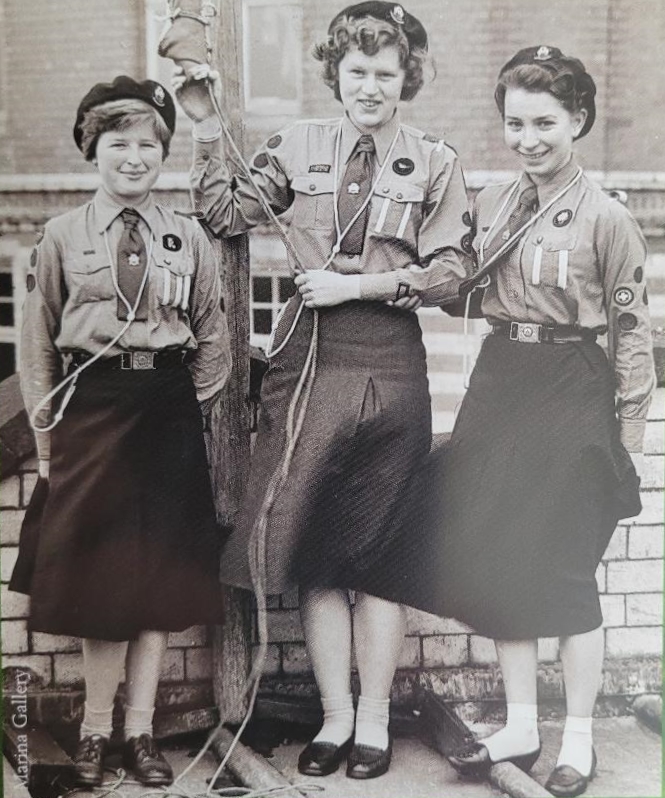
Where they clearly couldn’t agree, was on style of shirt and more especially, style of tie. Lets start by looking at the starting position, the Guide uniform in January 1965. This had been broadly unchanged since the end of WW2 and consisted of navy beret with hat badge over left eye, Guide blue blouse with buttoned chest pockets and full-length sleeve, triangular tie folded in necktie form with Promise badge pinned in the middle, Guide belt and navy skirt.
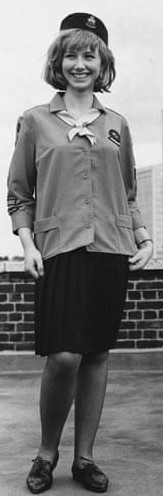
In September 1965 came the first major change – a new Guide blouse, with three-quarter sleeves, with the cotton being replaced by a new rayon ‘Guidex’ fabric which was intended for easier laundry. It had a fabric loop under the collar at either side, and zipped pockets just above the hem, the blouse being worn loose over the skirt not tucked in. The tie was now a mini neckerchief, which was to be rolled and then pressed flat with an iron, the ends passed through the under-collar loops, to cross over at the neck, the cross-over held in place by the Promise badge – or to be precise “The tie, is folded in half and worn scarf fashion, 1 1/4 inch wide with a 4 1/1 inch point, placed under the collar, point at the back, and pinned in front with the Guide badge.” – it’s not clear how strictly this was, or could be, followed. This was worn with a new ‘air hostess’ hat which was perched on top of the head, retaining the hat badge position over the left eye.
The idea of moving the pockets was popular – well-endowed Guides had sometimes been uncomfortable with the extra bulk added by chest pockets – but the shorter sleeves were not popular, partly with a view to year-round wear, and partly because shorter sleeves meant many keen Guides found there wasn’t enough room to stitch on all of the proficiency badges they were earning – it was soon necessary for the badges to be reduced in size as a consequence.
The uniform clearly wasn’t entirely popular, less than a year later, in August 1966, it was announced “The Executive Committee has agreed that the present overblouse may now be tucked inside the skirt as an alternative to wearing it outside. Of course, the old-type blouse must be worn inside the skirt only.

But the changes weren’t done yet. 16 months later, in December 1967, it was back to full-length sleeves, and a new tie – “Much thought has been given lately to the Guide tie and as stocks of the present size become exhausted they will be replaced by a tie made of superior cotton poplin costing 2s. 11d. Slightly smaller that the present tie and measuring 19 1/2 in. x 29 in. x 19 1/2 in., this should be worn single not folded double. The scarf should be pressed in order to give a flat appearance and then slid through a new Guide blue woggle, price 6d. The enrolment badge should be worn an inch below the woggle. The woggle will ultimately replace the loops on the overblouse as we felt it would give a neater neckline. The aim should be to obtain a neatly pressed flat effect, with the ends crossing at the neck-front as at present.” So back to blouse outside the skirt again, and the first introduction of a woggle to Guide section uniform – but not for long . . .

This style, however, only lasted for two years before the tie changed again. In December 1969 the Guide mini neckerchief replaced by pre-stitched cross-over tie, the crossover being held in place by the Promise badge. Recognising how recent the last two tie changes had been, instructions for converting existing mini neckers into a tie were given in the magazine and Guide Annual. And at last, there was a settled uniform for Guides, as this uniform lasted until 1981.
So, in the five years between January 1965 and January 1970 – the Guide uniform went through four significant changes, so some Guides would have been asked to change their style of tie two or three times during their time in the unit, with either the work of unpicking and converting, or the cost of buying new, each time. On that basis, are modern complaints about uniform chopping and changing every five minutes justified?
 Leslie's Guiding History