From the start, Guide units were encouraged to find their own premises, and to then improve them by creating their own furnishing and decorations. Suggestions were given for building simple furniture out of wooden boxes sourced from the greengrocer, colourwashing walls, and making simple curtains from inexpensive fabric. But as well as the major furniture and fittings, they were encouraged to make their home ‘Guidey’ with decorations and practical features. Part of this often involved decorations related to testwork.
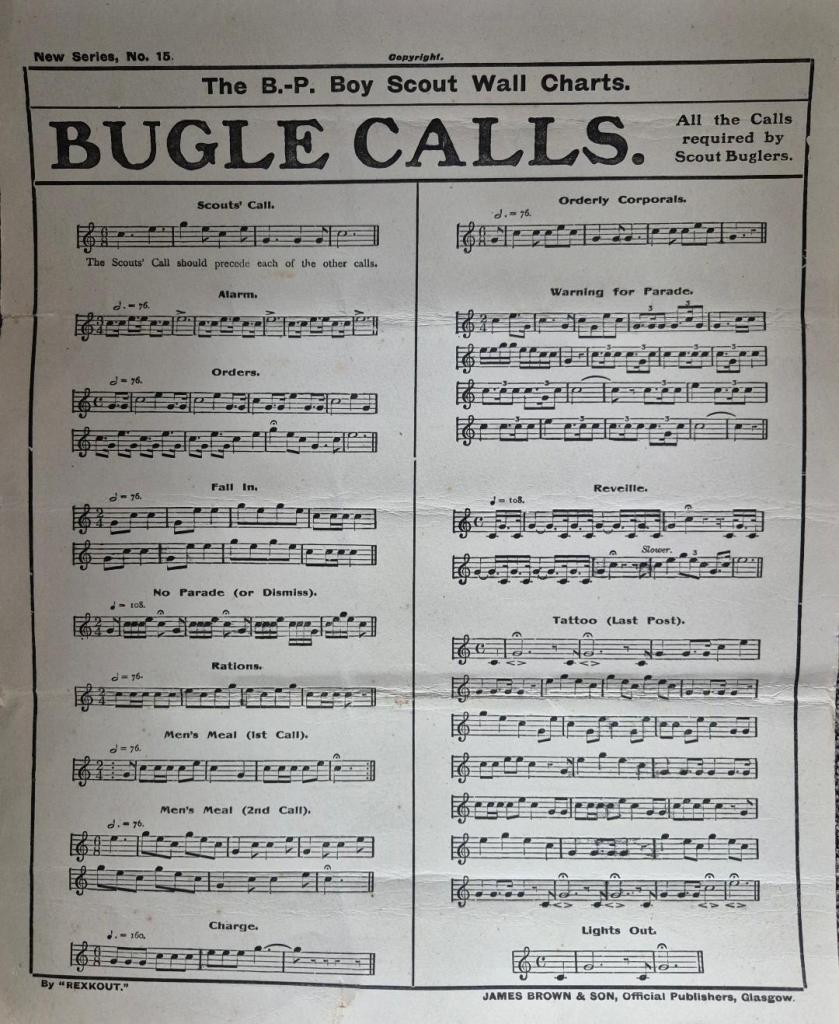
As a result, instructional posters were popular, and wherever there was a demand, Guiding’s publishers were ready to plug the gap. Initially, Scout posters were popular due to the amount of crossover in programmes between Scouts and Guides, such as this chart of bugle calls.
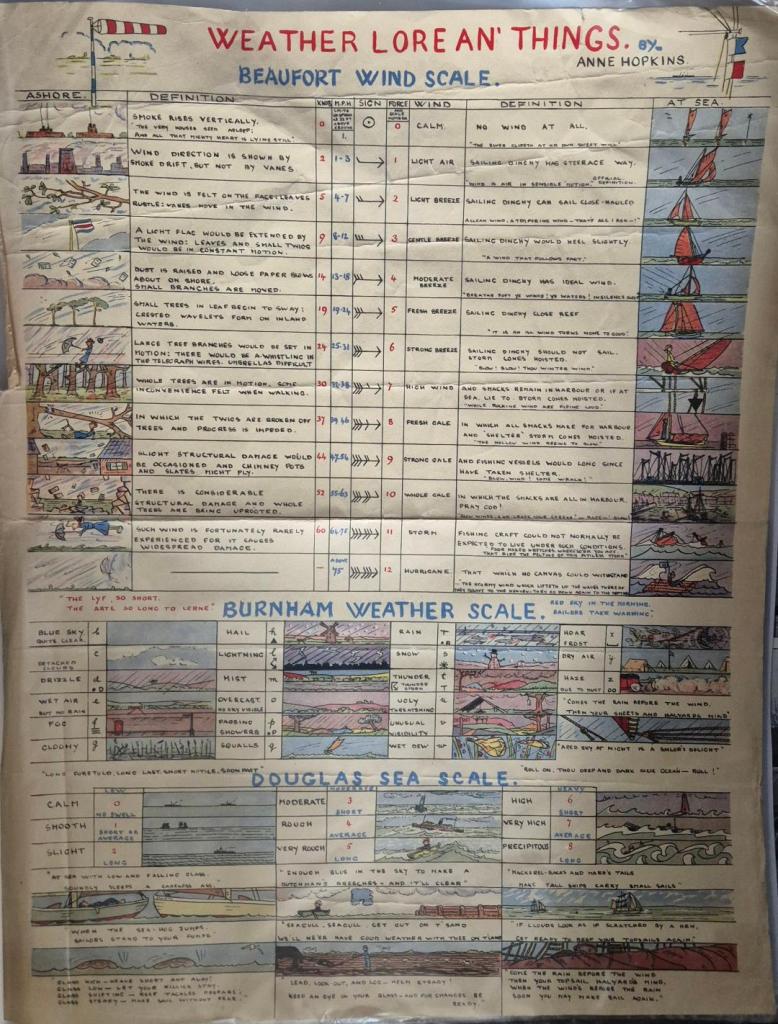
Before long, posters were being produced specifically for Guides, focussing on their programme. This was especially the case for Sea Rangers, who needed to learn a lot of meteorology and nautical terminology as part of their sail training. Posters such as this one by Anne Hopkins were designed to convey a lot of information in a compact and accessible form, including not just a beautifully illustrated version of the Beaufort Wind Scale (which is still in use today) but also of the Burnham Weather Scale and Douglas Sea Scale. The Guiding publishers, Brown, Son and Ferguson, also produced a number of posters on ships and shipping which, though not specifically marketed at Sea Rangers, were popular reference sources for members of Sea Ranger Ships.

WW2 brought a new programme for Rangers, and with paper rationing, issuing the details of it on a poster was more economical than publishing a full book. So although the programme’s details were published in the official magazine, a poster was also produced which detailed all the sections of the test, as well as giving detailed information on topics such as compass, anatomy, uniform, drill, highway code, first aid, and the specific tests for Sea Rangers. The illustration is a facsimilie, and printed over two pages, but it is fascinating to see how much detail has been squeezed into a comparatively compact space, covering such a wide range of topics.
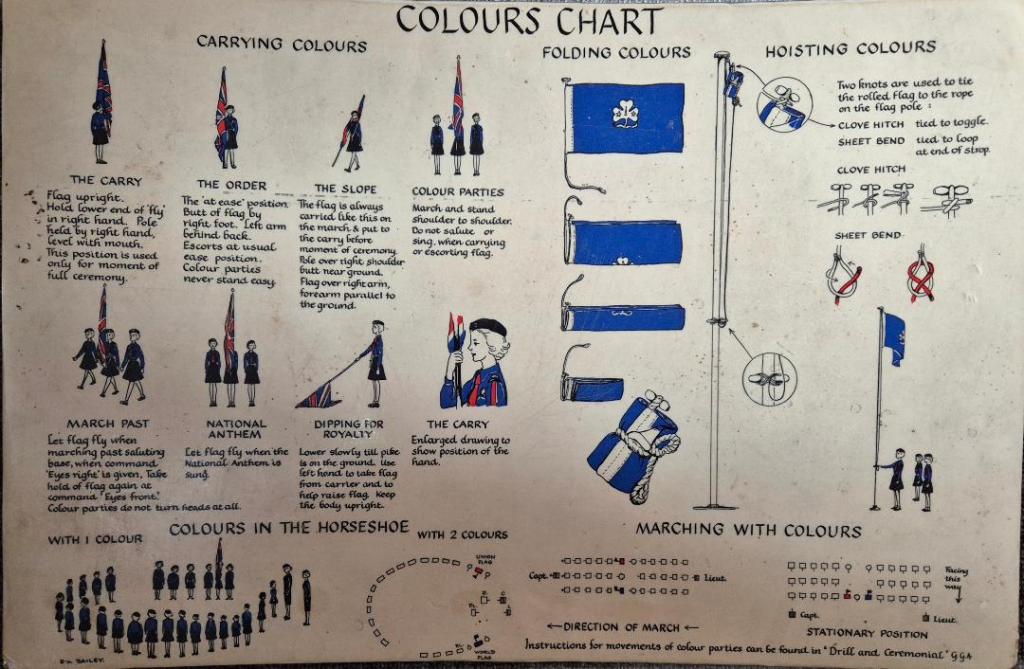
Posters continued to be produced after WW2, often to supplement the reference books available, or to temporarily replace where books were out of print. To illustrate, I have chosen a poster on ‘Colours’ – how to carry a flag, how to march with a flag, the ceremonial for using a flag in a Guide horseshoe – but also how to fold a flag in order to hoist it and ‘break’ it in a flag ceremony. With Guiding’s longstanding focus on smartness, there was a strong emphasis on handling flags smartly, respectfully and efficiently, hence many posters were produced over the years which gave instructions for this. We can see the attention to detail in the illustrations whish show exactly how each of the moves would be carried out, and when.

Posters weren’t just for Guides and Sea Rangers, however – as this Brownie poster shows. It gives details of the then Brownie Golden Badge Test – the challenges a new recruit was expected to master during her first 4-6 meetings prior to making her Promise. From knowing Brownie terminology such as the Brownie motto, ring, salute and smile, through practical skills such as washing up dishes and plaiting her hair, and onto the important task of memorising and understanding the Promise and Law, the poster was there to help recruits with pictures as well as words.
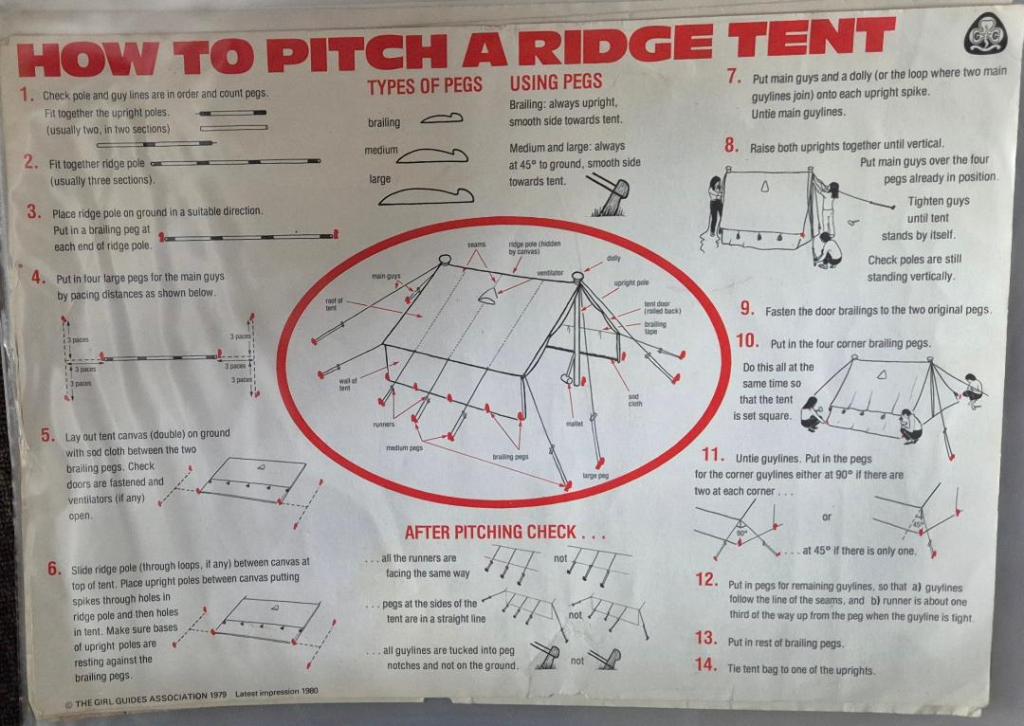
Practical skills, too, were a key feature, especially camp skills. Into the 1970s and 1980s, a series of posters were produced on topics such as stalking and tracking, pitching and striking tents, and firelighting. With increasing publishing costs, although the posters were still large, colour was reduced.
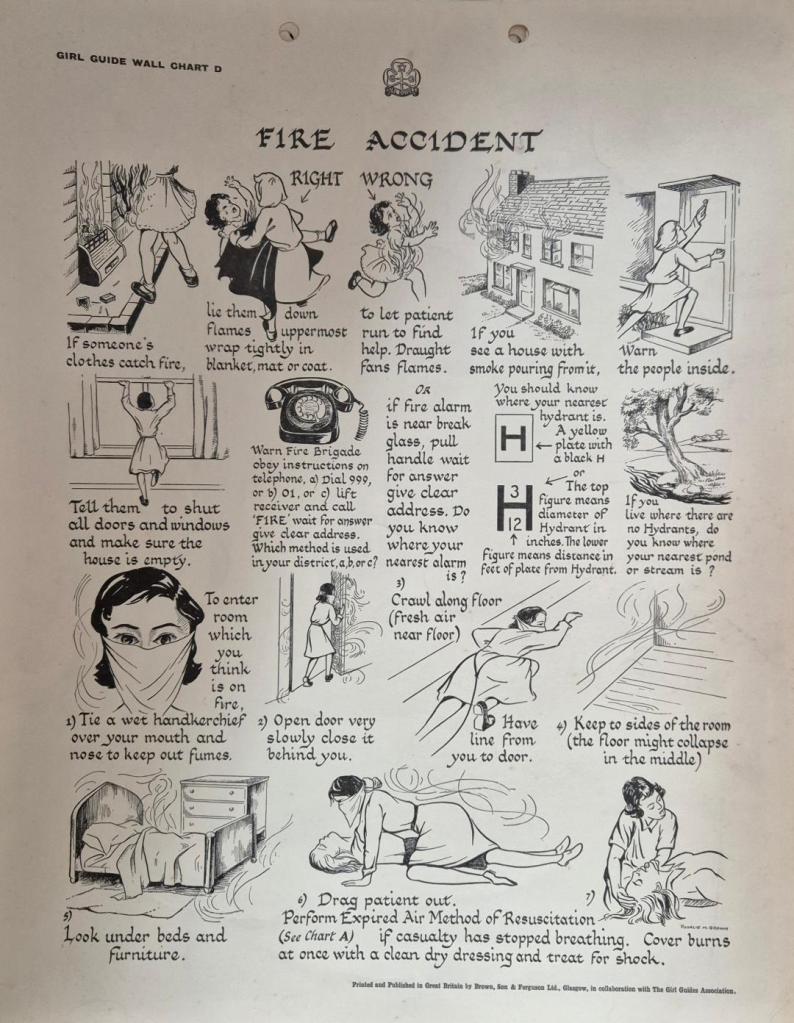
A popular series from this era was both lettered and illustrated by the well-known Guiding illustrator, Rosalie Browne. She created a series of posters on dealing with a range of accidents, which adorned many a Company’s notice boards in this era. With the ‘Be Prepared’ motto at hand, Guides learned what they could do in the event of a fire accident, ice accident, or other dangerous situation, in order to best cope.

As the 1980s progressed, the number of instructional posters produced by Guiding seems to have declined. Partly because safety instructions changed so frequently that it was hard to keep them up-to-date, and partly because other specialist organisations were producing relevant posters. Changes in media, too, mean that pre-printed posters are much less common than before. Nevertheless, it is fascinating to see the range of posters which Guiding produced, and the detailed information which was shared through them.
A final note – all of the posters illustrated are vintage, and in all but one case are original period posters from my collection. As such, they should be viewed in context as historical documents not current recommendations, as the advice contained within them may well not meet modern safety standards and practices.
 Leslie's Guiding History