Commissioners, Advisers and Trainers

Whenever an organisation grows to any size at all, it needs a structure, and Guiding was no exception. Although Guiding sprang up in many areas almost overnight, with Patrols forming, and joining together to become units under pioneer Leaders, some capable and inspirational, some less so, soon there needed to be a structure to bring units into the organisation, to interpret, implement and enforce the guidelines which were being trickling out from headquarters, and to support the Guiders who were doing the pioneering work. The 1912 handbook certainly helped in laying down some clear guidance on how things should be arranged, as did the publication of the first editions of ‘organisation, policy and rules’, and the columns of the “Girl Guides Gazette” and “The Guider”.
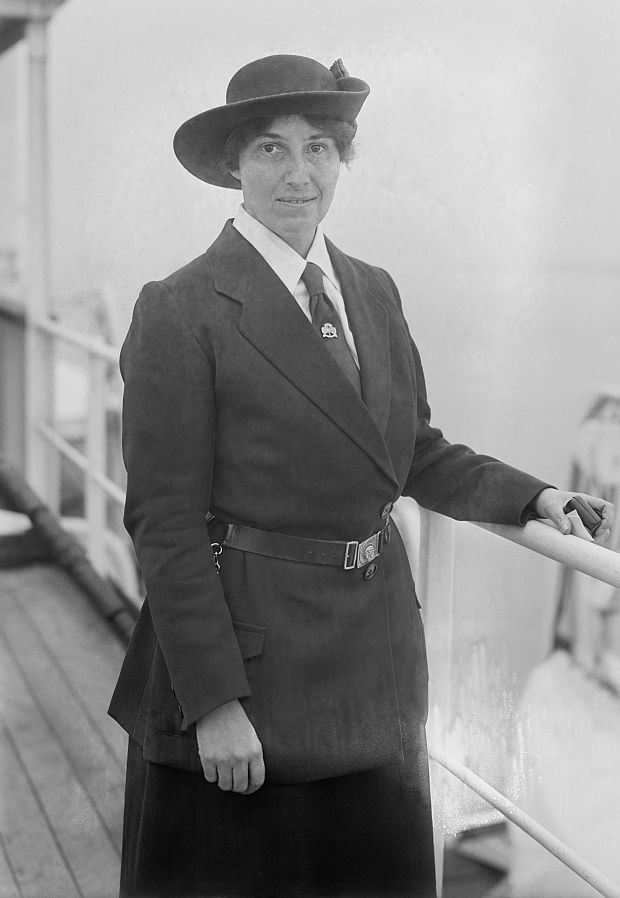
Initially, individual units operated in isolation, but with the growth in Guiding came the need for a more formal structured organisation, and it was in 1915 that CHQ was re-organised, and the first County Commissioners were appointed – by 1920 every County had it’s own County Commissioner. Lady Baden-Powell had a lot of influence in this, often writing to friends to urge them to become County Commissioners or Local Association members in their local Guiding County. In January 1917 the structure was a Chief Commissioner, and County Commissioners, each managing a team of District Commissioners, each of whom had a number of Assistant District Commissioners. By February 1917 the District Commissioners were renamed as Division Commissioners, and the Assistant District Commissioners became District Commissioners! So a structure was established with County Commissioners who reported to the National Commissioners for England, Ireland, Scotland and Wales. It was in 1971 that the Regions were introduced in England, to replace the Country structure in Engliand with more manageable-sized areas. In addition, there were Commissioners for Guiding in other Countries and territories which were part of the UK Girl Guides Association.
Commissioners
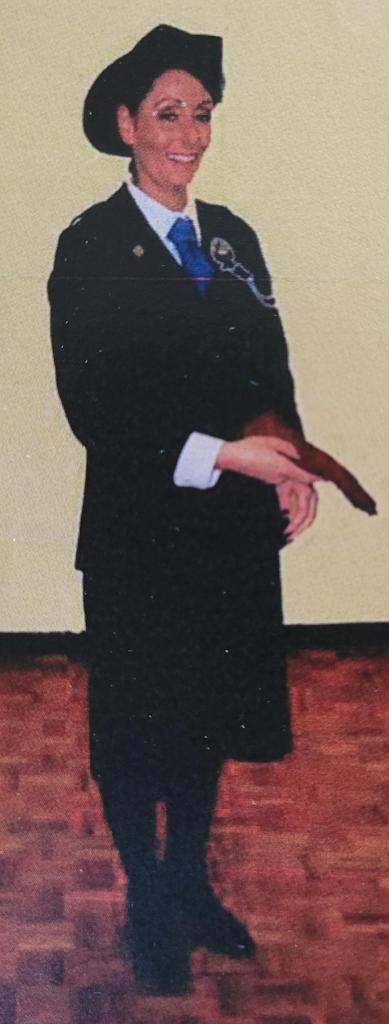
Commissioners were, and are, the ‘regional managers’ of Guiding. As the book ‘Notes for Commissioners’ put it, “A Guide Commissioner is the representative of the Girl Guides Association in her area, and she works under the Commissioner next above her. She is responsible for the well-being of the companies and packs in her area, and she is an essential link in the organization of Guiding.” So their job is to help and support the Leaders, to maintain ‘good Guiding’ in their area and, where necessary, to deal with problems which arise. They are also responsible for the reputation of Guiding in the community within their patch. Although it took time to fill all the vacancies in all the locations, within a couple of years of Guiding starting, there was a clear, hierarchical structure of Commissioners covering most of the Country.
County Commissioner
The County Commissioner is appointed by the Country/Region Commissioner and is responsible for Guiding in her area. in ‘Notes for Commissioners’ it is suggested “The County Commissioner should be an effective centrepiece in that it will be her part to appear on public occasions, to address meetings, to walk down guards of honour and to take salutes at parades, but that is not all; ultimately all the knotty problems that arise will come to her, she must be able to tackle difficulties, to advise wisely, and to deal tactfully and firmly with people and problems.” There may be fewer guards of honour or saluting parades nowadays, but the public face and the tackling difficulties part is still ever-relevant! Then as now, she also needs to have a handle on how Guiding is run in the County, and to manage it – this also involves liasing with outside organisations, particularly local council youth and education departments, but also with other youth organisations and similar bodies.

In the early years, County Commissioners wore Gold and Silver Cords around the left shoulder and pinned to the left lapel with a silver Promise badge, a navy uniform suit with white blouse and navy tie, and a silver cockade and silver cords on the hat. Later, a special diamond-shaped badge with a gold surround was introduced to replace the cords.
In the early years, the big role for Commissioners was to get Guiding established in their area. Many Commissioners put in a lot of work and generated a great deal of correspondence (in those days when home telephones were rare) in finding suitable people to be Guiders, in persuading local dignitaries and people of influence that a Guide unit would be a positive thing for the youth of the area, in helping the Leaders with support and to get the training needed, and in visiting (often scattered) units in their area to keep in touch with them.
Division Commissioner
She is appointed by the County Commissioner and has a dual role – to support the County Commissioner as one of her deputies, and to take charge of and support the District Commissioners who work under her. What sort of role this is will depend on the geography – whether she is dealing with a number of small towns in a compact area, or a large and sprawling area of countryside, or a mixture of the two. A Division would usually consist of between 3 and 8 Districts.

In the early years, Division Commissioners wore Silver Cords around the left shoulder and pinned to the left lapel with a silver Promise badge, a navy uniform suit with white blouse and navy tie, and a silver cockade but no hat cords. Later a special diamond-shaped badge with a white surround was introduced.
District Commissioner
She is appointed by the County Commissioner, after discussion with the Division Commissioner. As the ‘local manager’ she is immediately in charge of all the Leaders in her area, and can offer them help and support, and the opportunities they need to get training and development. She will visit the units occasionally in order to see for herself that they are progressing happily, and will hold regular District Meetings, to communicate information with the units and encourage them to communicate with each other. A District would usually be somewhere between 6 and 12 units.
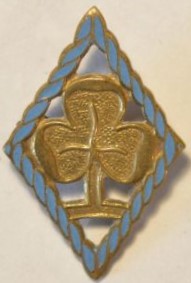
In the early years, District Commissioners wore saxe blue cords around the left shoulder and pinned to the left lapel with a silver Promise badge, a navy uniform suit with white blouse and saxe blue tie, and a saxe blue cockade and hat cords. Post-1968, Commissioners wore plain navy ties with the silver Promise Badge, and also a diamond-shaped Commissioner badge with a saxe-blue edge.
District Captain
She would help with organising joint District events such as rallies and parades, and might help with badge testing and training of new Leaders. The role was abolished in 1968. She wore a navy suit with a navy or white shirt, and a green cockade and tie
President/Vice President
Although normally such appointments were only made at County level (or above) it was possible for Districts or Divisions to appoint a President in the past. According to ‘Notes for Commissioners’ “These are usually well-known people who by sponsoring the Guide Movement in their area give assurance to parents and public that it is a reputable movement.” Uniform was optional for Presidents (since many were not members), their distinguishing marks were a coloured sash and a silver trefoil. Later sashes were done away with, and a special badge produced, featuring a Guide badge, and the word ‘President’ or ‘Vice President’.
The Modern Commissioner

The modern Commissioner’s role hasn’t changed much on paper, but the way it is carried out necessarily has changed. Formal occasions are few, and the ‘Guard of Honour’ or ‘Taking the Salute’ unknown. The uniform is from the same mix-and-match range as for Leaders, but with a plain coloured tab rather than one with a section stripe, the Commissioner badge being a discrete brooch worn on it. But the work of supporting local Leaders and units continues, District meetings are still held albeit usually by online videoconference, and the role is still based around encouraging ‘good Guiding’ in the community and maintaining links with local community organisations
Advisers
With the specialist skills Guiders were called on to have, especially camping skills, it soon became clear that specialists to serve as Advisers would be needed. Although many camps were well-run, inexperience meant that others ran into problems, especially where weather was inclement or the arrangements for catering or sanitation were found to be inadequate. So it became necessary to recruit Advisers for each County, to provide specialist training and share knowledge.
Over time it was found that there was also a need for Advisers to cover the arts subjects – to give advice on drama, singing, and handicrafts. Later advisers on watersports and hillwalking became common.
Trainers
With a new organisation, there was a need not just for structure, but also support and training for Guiders. Initial resources were limited, the pamphlets, the columns in Home Notes, in time the first handbook. But Leaders needed the skills to master the Second and First Class to the level of being able to teach it. So there was a need for training to be provided for Leaders. Trainings began in Counties, but the first centrally organised training was organised a residential training – this led to the founding of the Guiders Training School, GOTS. Then in 1918 it was suddenly closed down – it’s not clear why – and immediately replaced.
The next key move was the founding of the Training Centres. The founding of Foxlease in 1922 made training available not just to Guiders from across the south of England and parts beyond, but also to a large number of Leaders from what was then known as the Empire, and beyond – with it’s location near to the major port of Southampton. It provided the means for Headquarters’ training ideas to be spread worldwide. It also provided opportunities for Trainers to develop their skills – instead of weekly evening classes over a number of weeks, they were able to deliver comprehensive week-long courses.
During this time, as well as operating in the UK, trainers from the UK answered pleas from other countries to send trainers. Often, these visiting trainers would spend from six months to a couple of years living abroad and travelling around the country providing trainings to local Leaders.
Demand for training was increasing in the UK, and Foxlease could not meet the demand, so Waddow Hall followed in 1927, catering for Guiders in the north of England and Scotland, and increasing the available training opportunities. It was followed by Netherurd in 1945, and by Broneirion and Lorne in 1947, helping to make training available across the UK. Increasing numbers of training centres required increased numbers of trainers, so work was ongoing to recruit candidates and support them in gaining the training qualifications.
 Leslie's Guiding History