Yes, it’s that time again, UK Guiding is looking to do a redesign of the uniforms for all sections – the first full redesign across all sections since 1990. From the modern perspective, that 1990 redesign is often seen in a rosy glow or as a golden era. But was that how it was perceived back in the day? Lets look back and see what the Leaders of the day really felt about it!
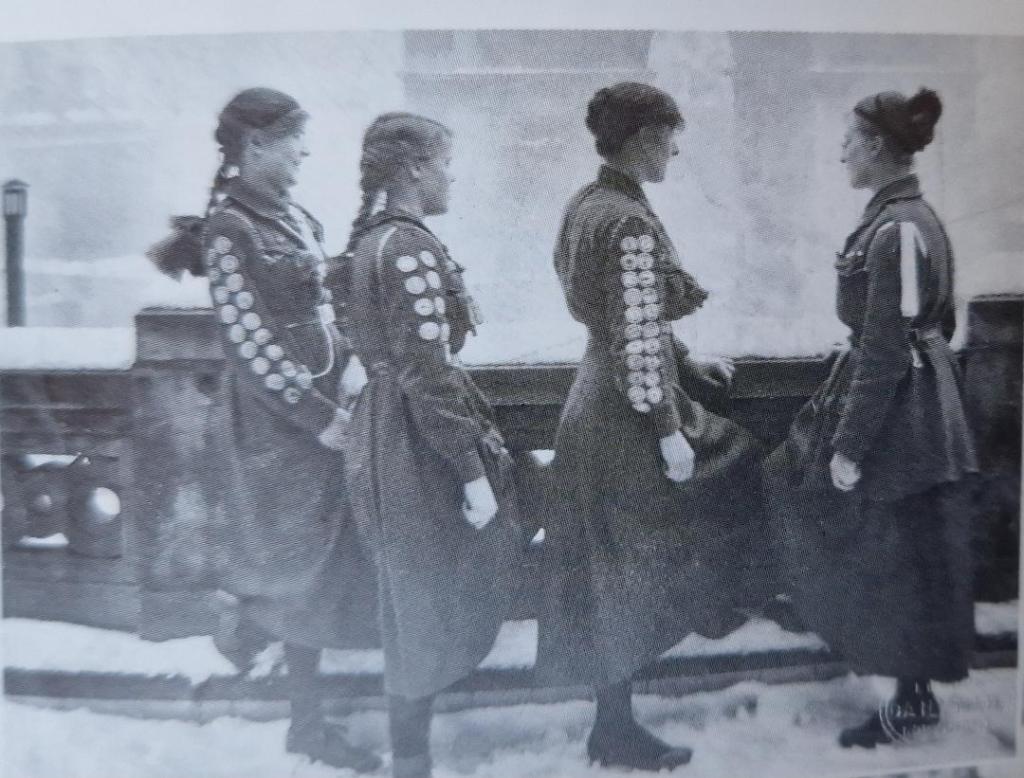
From the start, Guiding uniform was a dress for Brownies with a brown belt and straw or knitted hat, a blouse and navy skirt or blue dress and brown leather belt for Guides with a navy felt hat, a blouse and navy skirt or blue dress for Rangers with a navy felt hat, and a blouse and skirt suit for adults with a navy felt hat.

At that time, a blouse and skirt, or a dress, or a skirt and jacket set, were typical female wear at the time, so the uniform wasn’t far different to what the members would have worn as leisure wear during the rest of the week. And as it wasn’t considered appropriate to go outside the house without a hat of some sort on, so it was natural that a hat would be part of the uniform.
Problem was, that was true of the 1910s when the uniform was first introduced, and for several decades afterwards. But it changed across the 1950s and 1960s – whereas almost 80 years on, the Guiding uniforms were comparatively little altered from what they had originally been. Rainbows had been introduced, but their uniform was a simple tabard in red, blue, yellow or green, worn on top of whatever clothes they happened to be wearing, which allowed flexibility. But Brownies were still expected to wear thin brown cotton frocks year-round, with a cotton tie, brown wool hat and a brown belt – much like their grandmothers or great grandmothers had done. Guides were still wearing a blue cotton blouse with a navy skirt, a cotton tie, leather belt and a navy felt hat. Rangers were still wearing a blouse with a navy skirt suit and navy felt hat, Guiders were still wearing a navy skirt suit with blouse and ‘tie’, and navy felt hat. Though there had been tweaks to the styles and colours of the blouses and ties, and tights had replaced wool stockings, there had in reality been no more than tweaks over the 80 years.
By the 1980s time, the uniform was not typical of female wear at the time, and the uniform was very different to what the girls or women wore as leisure wear during the rest of the week. All of the girls and most of the adults wore trousers regularly in the evenings and at weekends, often in denim or corduroy, or wore ‘tracksuits’ as they were then known. Hats were only worn if appropriate to the weather – a warm wool hat in winter, a baseball cap or sun visor in summer to shade the eyes – even amongst churchgoers hat wearing on Sunday was now rare. So rather than go in for more minor tweaks to the uniform, such as had been made at various times over the years, in 1986 it was decided to take a completely fresh approach.
This wasn’t entirely out-of-the-blue – following a large Guiding event in London where some members had unfortunately suffered from hypothermia, one of the enquiry recommendations had been for Guiding to reconsider the clothing the participants had been wearing for an outdoor event, and a warm waterproof garment as outerwear was one of the enquiry recommendations.
To aid the headquarters uniform panel, it was decided to bring in an outside designer, and they opted to approach Jeff Banks – it was a real bonus that he not only agreed to take on the task, but offered his services free of charge! It was a massive coup – he was a household name as one of the main presenters on the weekly BBC programme The Clothes Show – and it gave scope for the new uniform designs to receive primetime coverage on that show. Unsurprisingly, he was made an honorary member of Guiding.
From 1986 through to the designs being presented to the CHQ executive committee in October 1989, there were questionnaires issued to members and fieldwork carried out, ideas were collected from groups of members, and work begun on designing the uniforms for each section. From the feedback it was decided that a mix-and-match range would be needed in order to produce a uniform which met all of the practicality and cultural needs. Colours were picked out for each section – sunshine yellow and forest brown for Brownies, Guide blue and navy for Guides, a much deeper aquamarine shade with navy for Rangers and Young Leaders, and blue and white shades for Guiders.
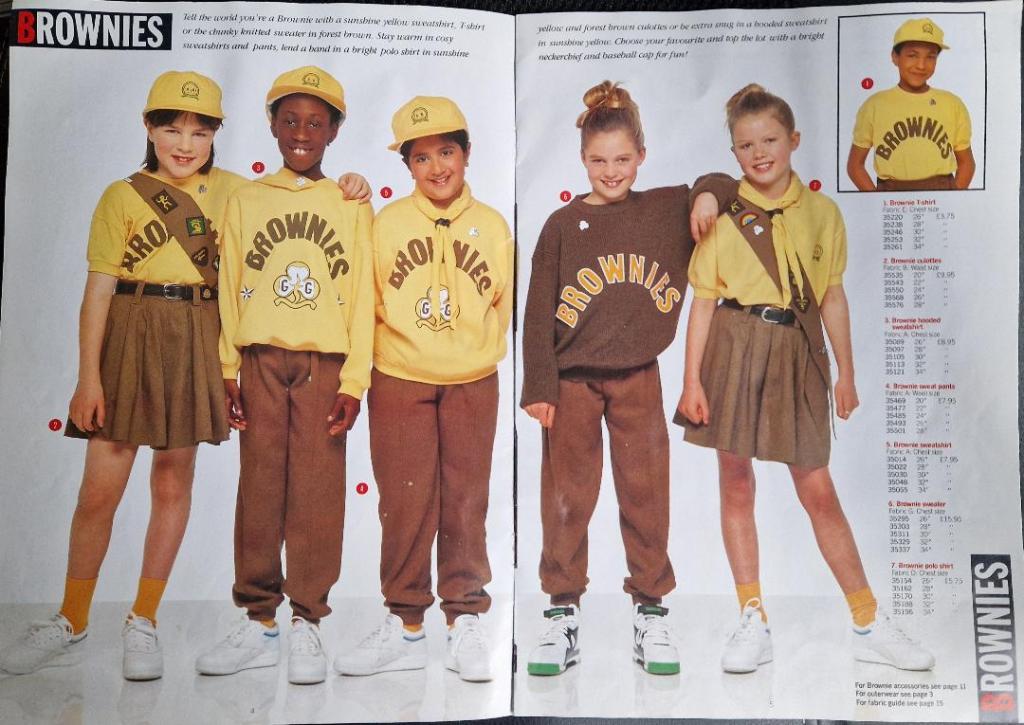
Brownie tops were mainly in yellow – the t-shirt, polo shirt, sweatshirt or hoodie – or a brown rib knitted jersey. These were worn with a choice of brown knee-length culottes or brown jogging trousers. To these could be added a brown belt, and the new brown sash with metal sash pin and chain, yellow baseball cap, and yellow necker with woggle. Of these, the jumper did not prove popular, probably down to price - where the sweatshirt and hoodie were £7.95 and £8.95 respectively, the jumper was £15.95.
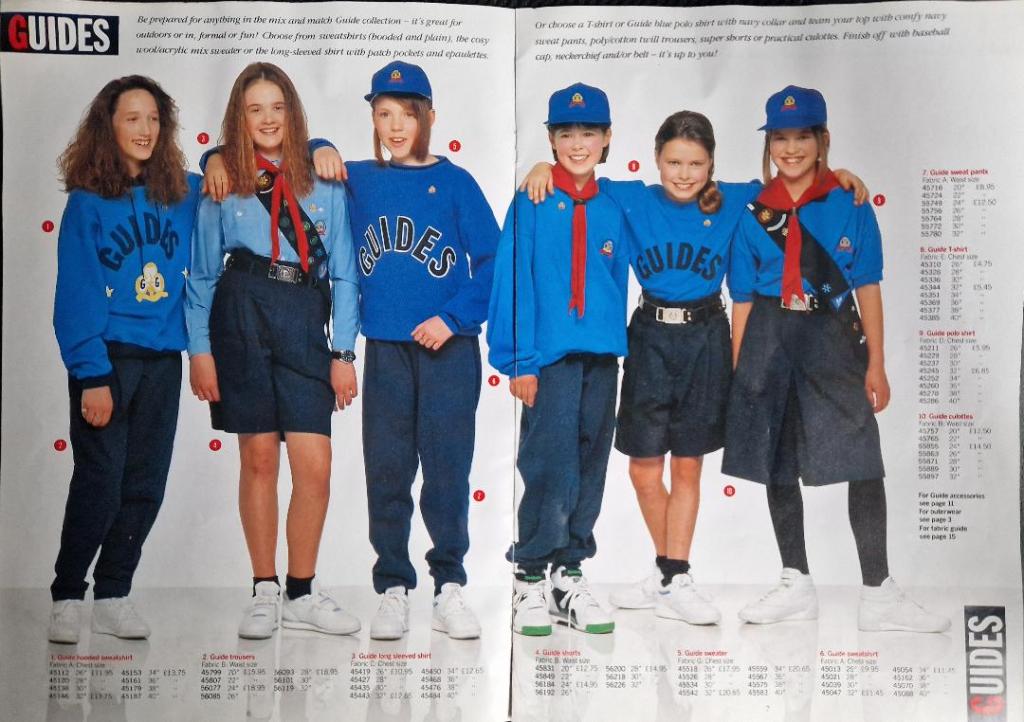
Guides had a slightly wider range of options – the tops were t-shirt, polo shirt, sweatshirt, hoodie, knitted jumper or a long-sleeve shirt in a denim colour. These were worn with a choice of navy trousers, joggers or knee-length culottes. The brown leather Guide belt was retained, as was the unit necker with brown leather woggle. New accessories were the navy badge sash with sash pin and chain, and the Guide blue baseball cap. Again the knitted jumper option wasn’t popular – the sweatshirt was £9.95 or £11.45 dependent on size, the jumper £17.95 or £20.65.
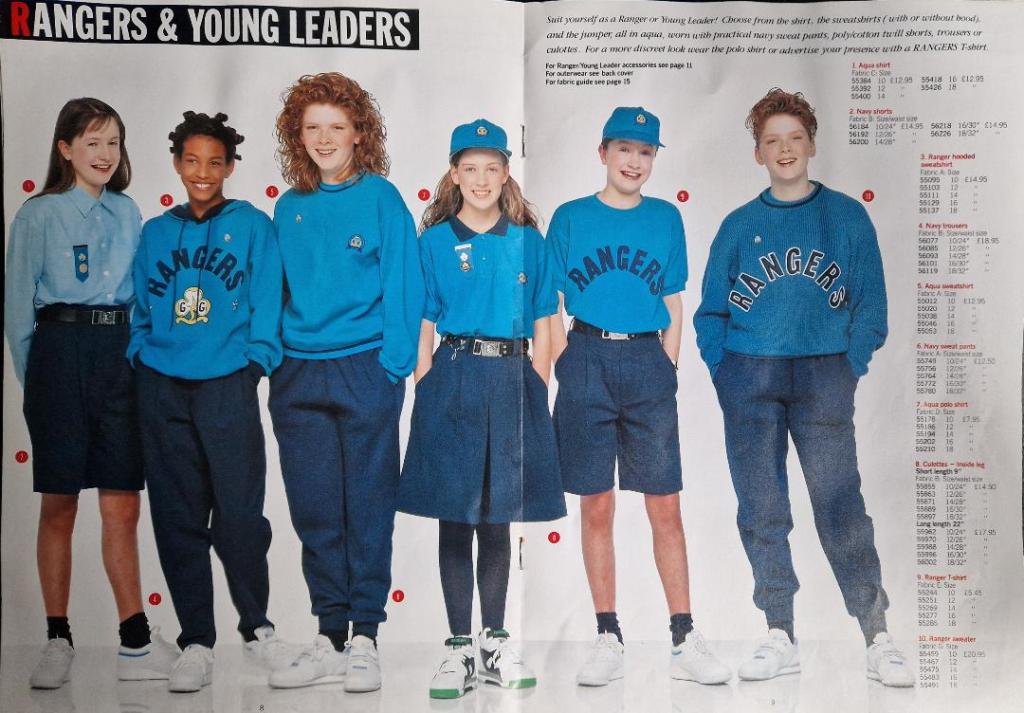
For Rangers there was a t-shirt, knitted jumper or hoodie with Rangers lettering. Open to both Rangers and Young Leaders were the polo shirt, sweatshirt, and long-sleeve shirt in a denim-style fabric. There was also a t-shirt for Young Leaders with logo. These could be worn with navy knee-length shorts or culottes, trousers or jogging trousers. A new ‘badge tab’ of aquamarine ribbon on a pin could be worn to display pin badges, and there was an aquamarine baseball cap.
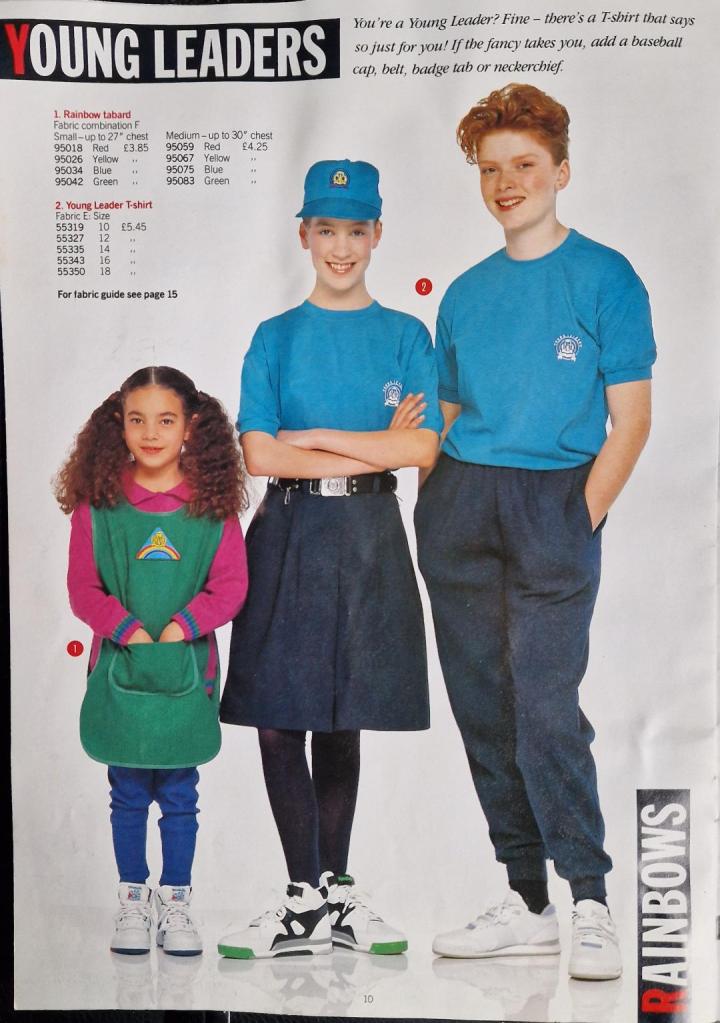
Rainbows, on the other hand, missed out entirely. Having only been introduced three years earlier, in 1987, they continued to have the tabard, with units having the choice of red, green, blue or yellow. It was only some time later, after much campaigning, that a green baseball cap was added to the range as an option for Rainbows, and that purple and orange were added to the range of tabard colours.
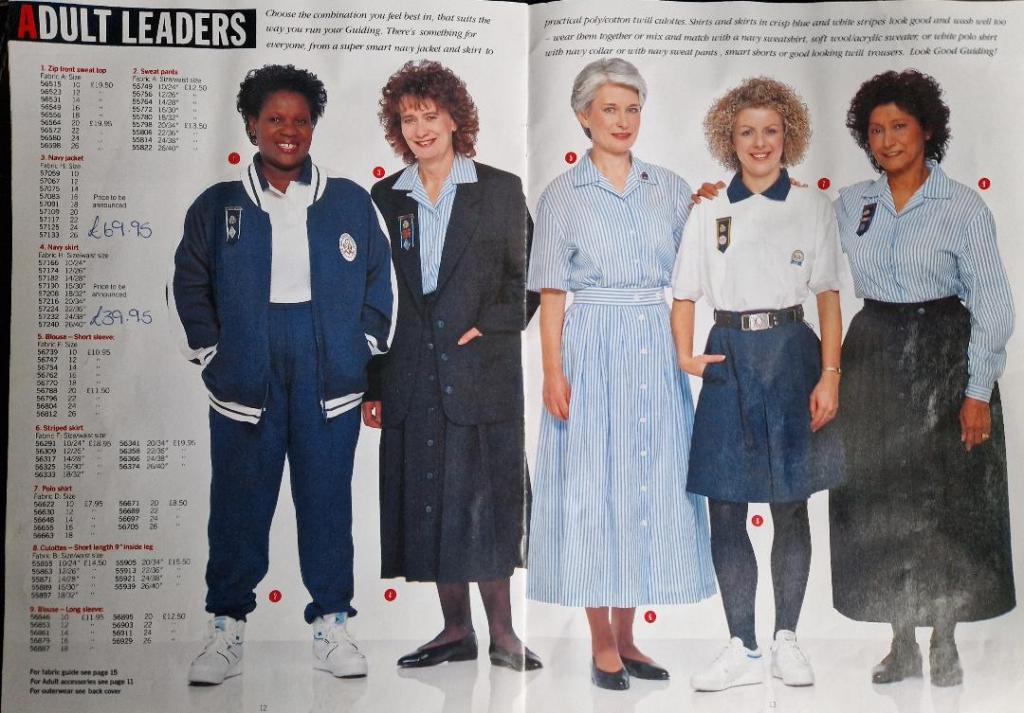
Adults had by far the biggest range of options to choose from. There was a polo shirt in white with navy collar, or a v-neck darted blouse in light blue and white vertical stripe, in long or short sleeve. There was a matching ankle-length button-through skirt in the same striped cotton. There was a zip-fastened sweat top in navy with broad white stripes on the sleeves and cuffs, or a blue sweatshirt with a white stripe on the collar and cuffs, or a light blue knitted sweater with similar trim. Or a navy skirt suit with longline jacket and button-through long skirt. Or navy trousers, or joggers, or short culottes, or long culottes, or shorts. There was a navy baseball cap, and a badge tab in navy – plain navy for Commissioners and Advisers, with vertical stripes on either side in section colour, for Guiders.

Of these options, the most controversial, surprisingly, was the navy skirt suit – but again this was on price grounds, for although all the other garments came in at under £20, there was a delay in announcing the price of the suit, and the price turned out to be £39.95 for the skirt and £69.95 for the jacket, putting it out of range for many.
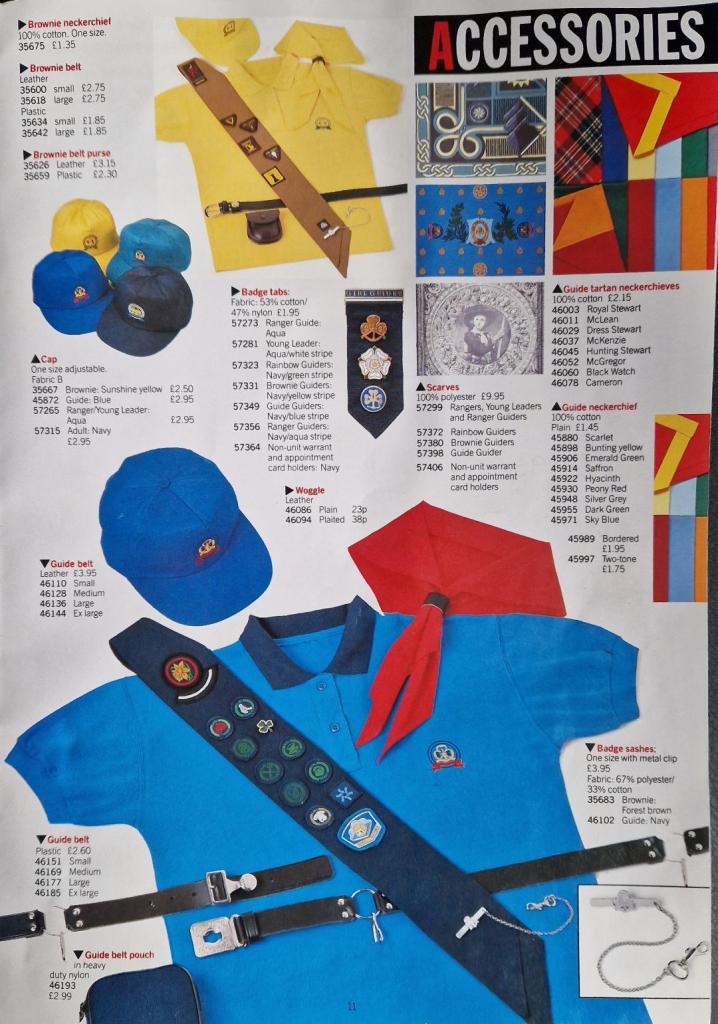
There were also new accessories – Rangers, Young Leaders and adults did not wear neckers, but there were new polyester scarves – one design for Rangers, Young Leaders and Ranger Guiders, plus ones of a similar design but in section colours for Rainbow, Brownie, and Guide Guiders respectively, and another for “non-unit Warrant and Appointment Card holders”. The new sashes for Brownies and Guides came with sash pins to hold the ends closed – these had a chain which could be hooked onto a D-ring on the cullottes or trousers (though these did cause some bathroom issues for Brownies).
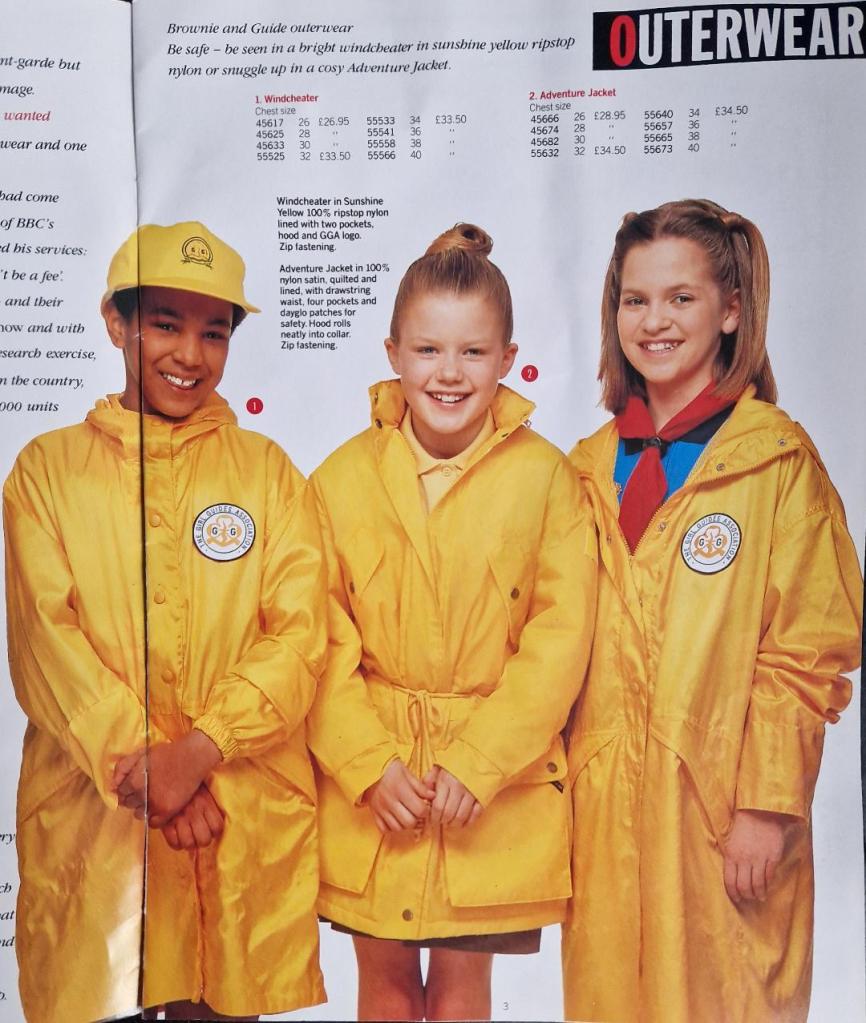
And there were new uniform waterproofs for all sections – a longline nylon windcheater waterproof coat, or a shorter lined and padded ‘adventure jacket’ – both available for all sections, in bright yellow. Though it stood out amongst crowds, that and keeping it clean may have been reasons why they did not last long?
Of course it wasn’t a smooth process – there were significant delays in manufacture and distribution. When it launched in September 1990, some of the items weren’t initially available in the shops – but there was a mad rush to buy, and reports of leaders trying on garments in the middle of the CHQ shop! There were major problems with sizing – one leader who normally wore size 16 as standard ended up with garments ranging from size 12 to 20!
From this distance it is often assumed that the new uniform received a universal positive response – but of course, that was by no means the case – a quick perusal of the letters page in the “Guiding” magazine shows that some were very strongly opposed. The first pictures of the uniform appeared in the May 1990 issue, with the first comments in the July 1990 issue. One wrote “Surely now, we have lost the smartness of our uniform and have just fallen victim to the slap-happy way that the younger generations seem to prefer. I suppose, when this ‘uniform’ is out of date in three years time, we shall really get down to jeans and oversized T-shirts.” Another asked “Has no thought been given to the Guiders who are no longer in their ‘first flush of youth’? I know of two such Guiders who are threatening to hand in their warrants if they are made to wear baseball caps and culottes.” A Bluetit Patrol wrote “We go to church regularly, wearing baseball caps and trainers is not our idea of smart. In a short while, the trainers, culottes and caps will be out of fashion. In our opinion Jeff Banks would do well to scrap the whole thing. The prices are outrageous for what they are, and the colours are awful.” Yet others were in favour – “The new uniforms are great. They are comfortable, fun and practical. Best of all, the girls like them.”
The August issue brought more complaints – “the Brownie uniform is just like McDonalds” ”The Young Leaders feel there is nothing smart enough for parades, and the Scouts will make fun of them. Many of them are thankful that they will have completed the scheme before the three year deadline expires.” ”The gathered skirt is far from flattering to those with a fuller figure. The skirt, almost ankle length, is dowdy and would be difficult to shorten. In fact, when tried on a below-the-average-height Guider it touched the ground. Only the average or above person could wear this, and would need to be size 14 or less.” ”The uniforms were displayed at out Banner Service, and most Guiders were determined to stick to their old uniforms as long as possible.”
September 1990’s issue included letters reacting to the appearance of the Guiding contingent in the Queen Mother’s 90th Birthday Parade, all of whom had been wearing the new uniforms – giving a first opportunity for many to see the uniforms en masse. The reaction was not favourable: “The so-called uniform is much too informal and not at all smart. As for the Guiders’ clothes – nearly half of all Guiders are ‘cuddly’ and will look enormous in gathered skirts, and why should the sweat shirts have two white lines around our widest parts? I never thought I’d be glad to retire, but I am, because it will be before the new clothes become compulsory.” ”The people who represented the Guide Movement really let us down, they looked more as if they were on a day out to the seaside than representing a well-known movement. They would have looked a lot smarter if they had worn their old-style uniform” ”I was actually ashamed when I saw the Guides and Rangers parading. They looked more like ice-cream sellers than a smart uniformed movement. To parade in front of our Royal Patron in culottes and peak-caps – to me that was disrespect in the truest meaning of the word. Why has the smartness been taken away? Surely for the various parades we join in we should be able to look, as well as feel, smart – instead we will stand out like sore thumbs.” ”I waited eagerly for the Guide and Brownies to appear, when at last my patience was rewarded I felt nothing but horror at the awful sight they looked. There is only one word to describe them and that is ‘scruffy’. Please, please, please can’t we have a smarter uniform for formal occasions?” ”In a few years’ time we’ll be a laughing stock, like a lot of McDonalds’ waitresses. The answer sadly is quite simple, no more church parades for us. As Guiders we are volunteers and most of us have spent over £60 on a navy suit. What has replaced the blue uniform dress? The awful striped skirt and blouse hasn’t. Why oh why do we have to go American? The Movement started here, didn’t it?” ”What a shame for those girls, to dress them up like a lot of clowns. I believe that change is admirable, if it is for the better. But if I were a girl of tender years and wanting to join an organisation, I know which group I would choose: the girls who looked really smart, capable and proud, not a group ambling along trying to look American. I know you will say that is what the girls want; how sad they do not have better advisers.” ”I feel very disappointed in the Brownie ‘play clothes’ as I now feel they should be called. Was it so necessary to destroy the whole of the uniform? What a shambles they looked. All the smartness had gone.” ”the hats – what an insult to Guiding. I wonder what Lady Baden-Powell would have thought. I know one Brownie Guider who will not be on parade if she has to wear something so ridiculous.” One Guider’s husband turned to verse: “Where are the Guides that we once knew, Who were proud to be seen in distinctive blue? As a man I preferred that elegant type, To those who have slept in their clothes all night.” The magazine noted “A lone voice disagreed” – “When I first saw the new uniform I was horrified, believing they could never look smart on parade. Then, as I was watching, I was this group of girls looking smart, cool, modern and bright. I was just turning to my husband to say, ‘Now why couldn’t the new uniform look like that?’ when the announcer said ‘Here come the Girl Guides in their new uniforms’. I looked harder and saw a Guider in a new white top with culottes leading Guides and Brownies (in baseball caps) looking very relaxed and HAPPY. I take back everything I have said about the girls’ new uniform. They do look smart on parade.” Another wrote “I have just been reading ‘Your Letters’ in the July issue of Guiding. I wish some of your correspondents had been at my Brownie meeting on the day after the launch of the new uniform. I left some catalogues on a table for the Brownies to look at. The Brownies ‘erupted’ into the room full of chatter about the new uniform. They were so excited about it, it was an absolute pleasure just to stand and watch them leafing through the catalogue and discussing the uniform. They absolutely love it as does my young assistant (24), our Young Leader, who is 18, and so do I (I’m 49 and have been a Guider for 26 years).”
October 1990 issue, and although the uniform had yet to become available to buy, the opinions kept coming, and the views, although mixed, were still as heated! ”If I read one more letter from either a Guide or a Guider complaining that the new uniform is not smart enough for Church Parade, I think I shall scream. Just what are we teaching the girls? That they can only go to church if they are all dressed identically like an army platoon? That God hates trainers? Surely God – and the congregation – wants to see happy, smiling Guides on parade and, if beanpole Betty, wee fat Wilma and voluptuous Violet have chosen different items from the catalogue, is that important? I bet that they will all have baseball caps – and I will too!” ”I looked round my church last Sunday to see what people were wearing . . . We had all gone to church to worship God, not to judge one another by our clothes. Please let us accept the new uniform, stop wasting time and energy moaning about it and get on with Guiding.” ”I wonder if all the ‘moaners’ actually submitted their uniform ideas two years ago. I’m sure God will not mind what the girls wear just so long as they attend! My Brownies think the new uniform is great and so do I. I can’t wait to get a new blouse, which could be worn to work . . . The skirts, although long, can easily be shortened. Also gathered skirts will always be more in fashion than A-line ones. Come on Guiders, look to the future – change is necessary every now and then. It won’t be too painful to adjust.” ”It is bad enough to see the Colour party, at a Church Parade (of four Guides) without hats, but the prospect of three girls in different ‘uniforms’ spells disaster. No longer are Guides a uniformed organisation – and I am very sorry today’s Guides are not proud of so being.” ”I feel we have now lost our unique identity and given way to fashion and choice, which I do not believe we all wanted. Anyway how much of a choice do we have? Some parents cannot afford the basics of the uniform without having to keep up with their daughters’ desires to be the ‘same’ as their friends. Also how many Guiders can truly afford such an outgoing, even if we do have three years to save up!” ”We are in danger of losing the special pride that has always been associated with being a member of a ‘uniformed, worldwide movement’ and becoming another youth group with a logo, all for the sake of a fashion, which will be out-of-date in ‘no time’. I feel very sad about this and hope there is time to salvage something of our Movement’s credibility before it’s too late.” ”Our identity, sense of pride and uniformity has been thrown away. Far from opening our Movement out to encompass other youngsters, you are closing our doors to all but the children with money. There was very little wrong with our dress uniform . . . we looked smart and everyone recognised us. I feel the majority of Guiders and Guides agree with me. We feel you are attempting to turn us into a casually dressed, elite youth club and this we do not want. We were very proud of our uniform and those I have spoken to on the subject feel very let down and disheartened.” It was made clear that this would be the last issue of the magazine in which opinions would be published.
So if anyone claims ‘everyone welcomed the new uniforms in 1990’, you will know it’s not true. If anyone claims ‘everyone hated the new uniforms in 1990’, you will know that isn’t true either. In reality the outcome was the same as for every uniform change in the past, and will doubtless be the same for every uniform change in the future – when first announced there will be strong opinions, the majority of them very negative. During the first year of it being in use, some of the opinions will be toned down in strength although still opposed, or will disappear – whilst others will remain strongly for or against. After a couple of years it will ‘just be the uniform’ and accepted as such more or less happily.
 Leslie's Guiding History